The Prime Collection has always been about more than beautiful homes. It’s about how those homes feel to live in, how they hold memory, and quietly shape the rhythm of everyday life. As Prime enters its second chapter with the Paloma Collection, that philosophy continues through a new artistic collaboration, this time with Waddington Custot Gallery and Bolivian-born artist Kenia Almaraz Murillo. This is the second artist collaboration for August, and one that felt instinctively aligned. Kenia’s work explores heritage, migration and the emotional weight carried through materials, ideas that sit naturally within spaces designed to be lived in and defined by place. In conversation with Kenia, we spoke about memory, family, and what it means for her woven works to move from the gallery into the intimacy of the home.
Woven Histories
Kenia Almaraz Murillo’s practice begins long before the loom. Born in Santa Cruz de la Sierra, Bolivia, she spent her early childhood immersed in Aymara and Quechua culture, surrounded by craft and the rituals of daily life. When she arrived in France at the age of eleven, that world fell abruptly out of reach. For five years she lived without seeing her parents or extended family, a separation that would come to shape her work profoundly.
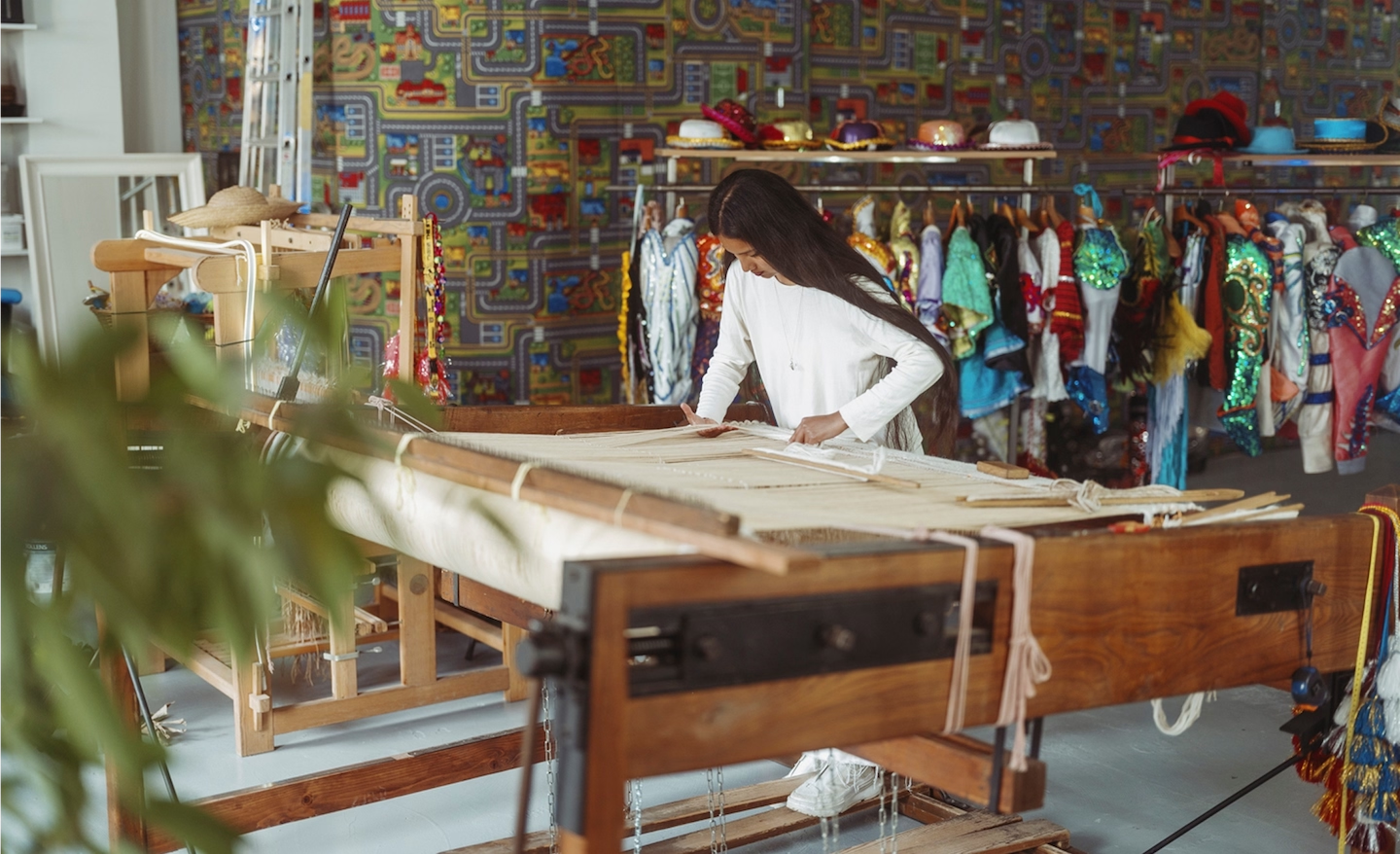
As Kenia tells us, weaving became a way of returning. Studying visual arts in Paris and later entering the Beaux-Arts, she encountered the technique of basse lisse weaving in 2015, a moment she describes as reactivating “the memory of the thread.” What followed was not simply a technical practice, but a deeply personal one: a means of reconnecting with family histories, ancestral skills, and the tactile knowledge passed down through generations of women in her family.
Her memories are vivid and precise. Being carried across the Rio Mauri in her mother’s aguayo. Sitting by the fire with her grandmother as she coaxed the flames. Walking through hills with her blind grandfather, guided by the sound of wind and the feel of stone underfoot. These moments don’t appear literally in the work, but they are embedded within it, felt rather than illustrated.