

August 13, 2026
The true cost of a holiday home in Europe in 2026
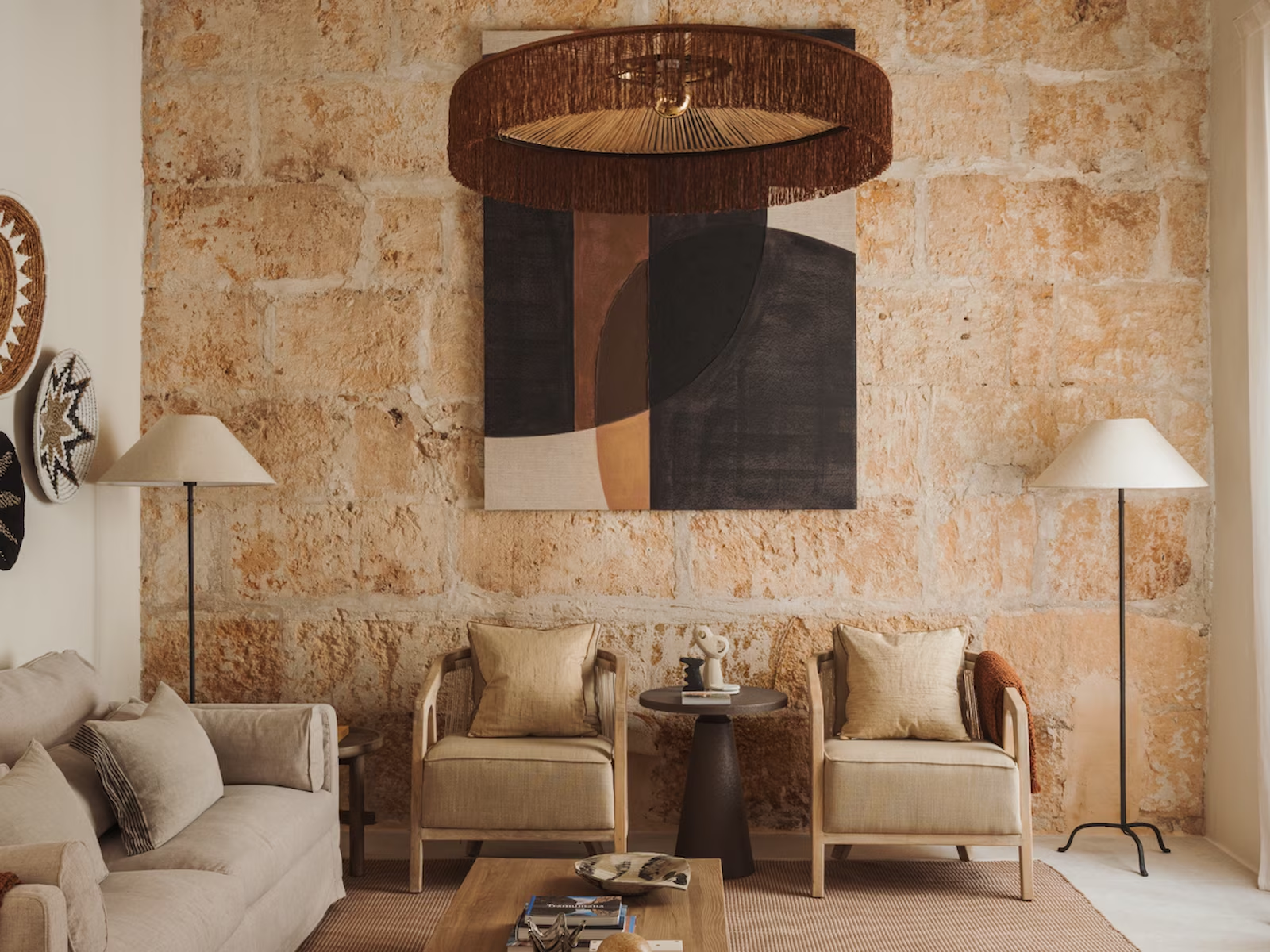
The purchase price of a holiday home in Europe is only the beginning of what it costs. Transaction costs alone can add close to a tenth of the price before a single night is spent there, and the costs of running a second home carry on regardless of how much time you spend there. August's Private Collection membership completely changes that picture – not a single property, but a curated Collection of exclusive homes across several destinations, and two ongoing costs, each of them stated openly.


The purchase price of a holiday home in Europe is only the beginning of what it costs. Transaction costs alone can add close to a tenth of the price before a single night is spent there, and the costs of running a second home carry on regardless of how much time you spend there. August's Private Collection membership completely changes that picture – not a single property, but a curated Collection of exclusive homes across several destinations, and two ongoing costs, each of them stated openly.
The true cost of a holiday home in Europe in 2026
The purchase price of a holiday home in Europe is only the beginning of what it costs. Transaction costs alone can add close to a tenth of the price before a single night is spent there, and the costs of running a second home carry on regardless of how much time you spend there. August's Private Collection membership completely changes that picture – not a single property, but a curated Collection of exclusive homes across several destinations, and two ongoing costs, each of them stated openly.
Owning a second home in Europe is a dream people hold for many years – they save up, romanticise their future family holidays and research the best place for it. The practicalities are what rarely comes to mind beforehand. Holiday home ownership has always carried a burden, behind the perfect holiday photographs. The dream is easy to picture – shutters thrown open on an early morning in June, the smell of the fields or the sea, somewhere that's yours. The accounting is harder to picture, and it's the part nobody advertises. Below we will explore what a second home in Europe costs to buy, what it costs to keep, and what changes when it's held as part of a collection rather than on your own.
In this article:
- What a second home in Europe actually costs to buy, once transaction costs and taxes are included.
- The ongoing costs of running a second home – from insurance and a caretaker to the time it takes to manage.
- How August’s Private Collection membership changes these costs.
- How much a membership costs and what the two clear, ongoing annual charges cover.
What does buying a holiday home in Europe actually cost?
The asking price is where every conversation for a holiday home purchase starts. But the numbers don’t end with that. The additional costs – registration and taxes – depend on the location.
In France, notary and registration costs on an older property come to roughly 7–8% of the initial price. In Italy, registration tax on a second home is 9%, and once notary, agency and legal costs are added, the total typically lands between 9% and 15%. Spain works out similarly, though the Balearics are among the most expensive places to buy in the country – transfer tax there rises in steps, reaching 13% on the upper portion of a higher-value home. In England, a second home carries a 5% surcharge on top of standard stamp duty, applied to the whole purchase price, with a further 2% if you're buying from abroad. On a million-euro house in Mallorca, that's over €100,000 in tax and transaction costs before you can call it yours.
Then there's the house itself – the part people rarely fully consider beforehand. The most charming homes are usually the ones with history behind them, and that comes with a list – a roof repair, the wiring, a new kitchen. Furnishing takes its own time and money before you can enjoy the summer there: finding pieces that suit the place rather than simply filling it.
What are the ongoing costs of owning a second home?
A home has a life of its own and needs attention even in your absence. The obvious annual costs usually include:
- Local property taxes – rates vary by country and municipality, and second homes are frequently charged at a higher rate than primary ones.
- Insurance – priced differently, and generally higher for a property that stands empty much of the year.
- Utilities and standing charges.
- Garden, pool and grounds – all need maintenance year-round.
- A caretaker – someone local has to hold keys, meet contractors, and check the property from time to time.
- Opening and closing. Preparing a home for the season and shutting it down afterwards is its own recurring cost.
- Repairs – the boiler, the roof, the pump. These arrive without warning and rarely at a convenient moment.
There are several ongoing costs and requirements that new homeowners tend to overlook. One of them is refurbishment. No home stays as it was the day it was finished. With time, interior and furniture, kitchen and bathrooms date and need refreshing. It comes round every few years and it is a considerable cost, but easy to miss – it never arrives as a bill.
Then there is your time. None of the tasks around managing a home are difficult on their own, but they add up to hours a homeowner rarely accounts for, usually spent from a distance, maybe in a different time zone and language to the house itself. It's the cost that doesn't appear on any invoice, and the responsibility owners feel most acutely.
None of these are unreasonable or surprising. They're simply the costs of owning a house and every homeowner pays them. What tends to surprise people is how steadily they gather across a year.
There's a further cost that rarely shows up until a homeowner decides to sell. A single house, in a single place, depends on the market for that one property – and that market can be narrow, especially outside peak season. A share in a Collection sits within a wider pool of interested buyers, and August's homeowner experience team is there to guide a member through resale (known as Private Sales) when the time comes.
How does Private Collection membership change those costs?
Most owners enjoy their holiday homes only a handful of times per year – a good stretch in summer, around Christmas holidays, and perhaps a few long weekends. The costs and management, meanwhile, don’t take time off. If you look at the numbers across a year, the cost per night spent in the house is much higher than imagined. That's not an argument against owning. There are lovely reasons to own rather than book – walking into a home, leaving your summer clothes in the wardrobe, the feeling that you belong.
This is where August's Private Collection membership comes in. Rather than one home, paid for in full and used occasionally, a homeowner holds a share across a curated Collection of four or five exceptional homes, each in a different corner of Europe, each managed to the same impeccable standard. It's a second home without the management – no repairs to handle, no caretaker calls, and no winter checks to arrange while not there. The homeowner experience team takes care of all that, on your behalf, across every home in the Collection.
The costs don't disappear. They're restructured. Instead of one homeowner carrying every tax, repair and empty month alone, the running costs of each home are shared across the members of the Collection and set out as two clear, ongoing charges – confirmed at the point of purchase and explained plainly.
It's the same principle behind owning – arriving home each time – without carrying alone the full weight of a house that sits closed for most of the year.
.avif)
What costs does a Private Collection membership involve?
Similar to buying a home outright, joining a Collection starts with the share price paid upon purchase. It varies by Collection – recent prices have ranged from around €405,000 to €1.80 million, depending on the size of the homes and the destinations.
Beyond that, the costs involved in a Private Collection membership are structured differently from those of traditional ownership. The membership carries a set of ongoing costs that keep every home in the Collection to the same exceptional standard – each with a purpose, explained clearly and nothing arriving as a surprise.
The Annual Maintenance Charge is the yearly cost of running the homes day to day – insurance, utilities, garden and pool care, a local caretaker, opening and closing for each season. It's the same list of costs a sole owner pays alone, shared instead across the Collection.
The Sinking Fund covers the larger, planned works every home eventually needs – a roof, rewiring, replacing a boiler – the kind of cost sole owners rarely plan for until it arrives. Contributions are set aside annually, so the expense is never a surprise.
Together, the two replace a single homeowner's open-ended list of costs with something structured, predictable, and confirmed before you collect the keys.
Owning a home in Europe should be a pleasure, not an administrative exercise. If you'd like to see exactly what costs a membership involves – the share price, the annual charges, and what each one covers – explore the Collections or get in touch. We'd be glad to walk you through it.
FAQ
What does it actually cost to buy a holiday home in Europe?
Beyond the purchase price, transaction costs – fees, registration and local taxes – can add close to a tenth of the price before a single night is spent in the new home. The exact figure depends on the country’s tax law.
What are the ongoing costs of owning a second home?
A sole owner covers local taxes, insurance, utilities, garden and pool care, a caretaker, and the periodic cost of repairs and refurbishment – plus the time it takes to manage all of it, usually from a distance. Private Collection membership brings these together into two ongoing annual charges: the Annual Maintenance Charge and the Sinking Fund, so each home is managed to the same standard.
What costs does a Private Collection membership involve, beyond the share price?
Alongside the share price, membership carries two ongoing costs: the Annual Maintenance Charge, which covers day-to-day maintenance such as insurance, utilities and garden and pool care; the Sinking Fund, set aside gradually for larger, planned work. Each is explained clearly upfront and nothing comes as a surprise bill.
neem deel aan ons volgende WEBINAR:
Vul het onderstaande formulier in om uw plek te reserveren
De gegevens om deel te nemen aan het virtuele evenement worden per e-mail verzonden.
Ontdek August, het concept en hoe je huiseigenaar kunt worden.
Kom meer te weten over onze collecties en ervaar enkele huizen
Begrijp het proces om lid te worden
En al je vragen zijn beantwoord
RSVP om een plek te reserveren. De gegevens om deel te nemen aan het virtuele evenement worden u binnenkort toegestuurd.

1. Inleiding tot het August-
concept
Ontdek meer over August, ons unieke mede-eigendomsmodel en hoe je huiseigenaar kunt worden
2. Huizen en collectie
Lees meer over onze unieke soorten collecties, onze huizen en welke collectie bij jou past
3. Van een huis naar een thuis
Luister naar huiseigenaren, die hun ervaringen zullen delen en zullen helpen om uw vragen te beantwoorden
brochure aanvragen
Begin uw reis naar een tweede huisbezit door een kennismakingsgesprek te regelen met een lid van ons expertteam.